The High Priestess
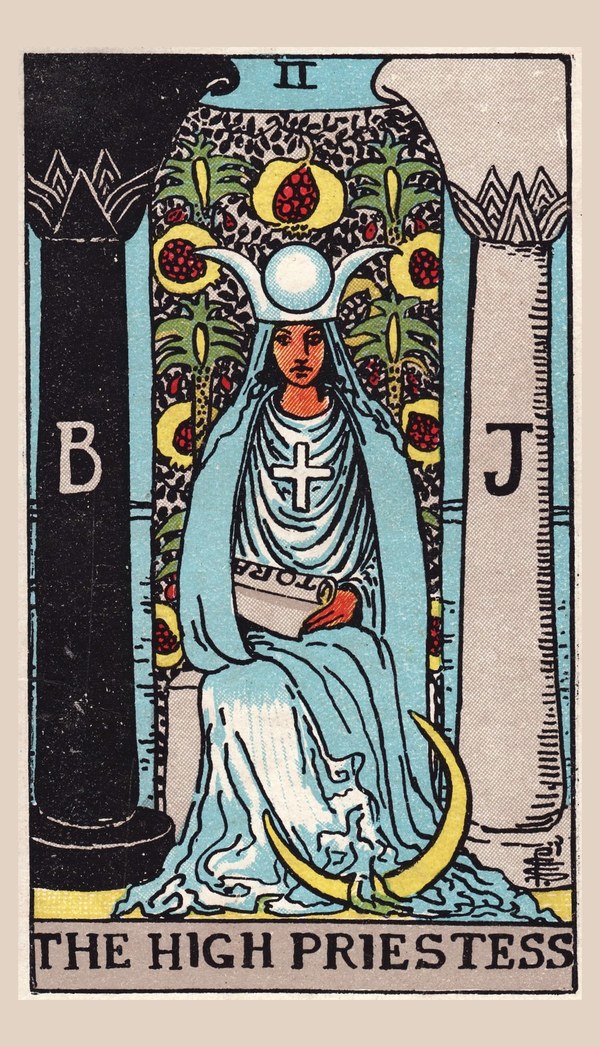
She knows, and she is not telling. Yet.
The unspoken knowing.
upright
Known, and not said.
Stillness, and what is known without being said. The veil stays down. The card asks you to wait, to sense rather than act, and to trust the part of you that knows more than it can explain. But stillness at the wrong time, or kept up too long, turns into weakness: fear of life and of other people, a knowing that never becomes doing.
upside down
Intuition drowned out.
The veil lifts, or is torn. A turn toward passion, toward throwing yourself into life and other people. Swung too far, intuition is drowned out by noise and the sense of your inner self is lost. Time to come out from between the pillars and take part.
in the picture
- The pillars. Two pillars, black and white, marked B and J. Boaz and Jachin, the pillars at the door of Solomon's temple. Everything opposite, and her between them, keeping the door.
- The veil. A veil of pomegranates and palms, and behind it, just visible at the edges, water. She sits in front of what is hidden.
- The scroll. A scroll, half hidden by her cloak, marked TORA. Now read the letters round: TORA, ROTA, TARO. The wheel.
- The moon. A crescent moon, lying at her feet. What waxes and wanes, what is felt and not said, moves through her.
- The crown. Two horns with a full moon between them: waxing, full and waning in one shape. Isis's crown.
- The cross. A cross with four equal arms, white on blue. An old sign of the sun, and the moon's priestess wears it. Three cards on, the Hierophant's cross has three bars, one above another. Hers is level. His is a ladder.
- The robe. Blue, and at the hem it stops being cloth and becomes water. It runs from her feet out of the picture. Her robe flows, thin as gauze. The pool behind the veil does not move.
on the road
The Magician acts. The High Priestess sits. He is the first card of doing and she is the first card of knowing, and the deck puts them side by side so that neither can be mistaken for the whole. Two is the first split: as soon as there is one thing there is the other thing, and she sits exactly between them, a black pillar on one side of her and a white one on the other. The letters on them are B and J, for Boaz and Jachin, the two bronze pillars that stood either side of the door of Solomon's temple in Jerusalem, the one the old stories say was built to hold the presence of God; one pillar was called Strength and the other Establishment, and you passed between them to go in. The deck has made them black and white, everything opposite, with her between them, keeping the door. Look closer: the letter on the black pillar is white, the one on the white pillar black. Each opposite carries a grain of the other. So are you, looking at her. That is the first thing the picture does: it puts you at the temple door, between two things that cannot both be true, and lets you see that sitting there is a kind of knowing.
Behind her hangs a veil of pomegranates and palms, and behind the veil, just visible at its edges, water. She sits in front of what is hidden. You do not see past her; you see her, and she is the door. The veil says you are not in yet. What it keeps is the water, and the water is the point. Look at the hem of her robe: it stops being cloth and runs out of the picture as a stream. The pool itself does not move. Its secrets are in the depths, under a smooth surface. Nobody can stir it yet. Fifteen cards on, the Star pours into the same water, and the Moon's crayfish climbs out of it.
In her lap, half covered by her cloak, a scroll marked with four letters. The law, partly shown. Read the letters round and they make the deck's own name, and eight cards on the Wheel of Fortune will spell the same word round its rim, out loud, turning; here it is still, and half of it is hidden on purpose. She knows, and she is not telling. Yet. On her breast a cross with four equal arms, an old sign of the sun. On her head the horns of the old moon goddess with the full moon between them, waxing, full and waning in one shape, and at her feet a crescent lying on its side. The moon's month and a woman's month are the same length. She wears the whole cycle, the sky's and the body's, because in her they are one thing. The moon's light is borrowed, and it is light for everyone.
So she is the other half of the Magician in every particular. He is fire; she is water. He points; she holds. He gives everything through his hands and keeps nothing; she says some of it and keeps the rest. What she keeps stays behind the veil until the cards far down the road can stir it. He stands; she sits. He works in the open under a yellow sky; she sits inside, before a veil, and her sky shows only at the veil's edges, over still water and a line of hills. The deck needs both to make anything, and the next card, the Empress, is what they make together: his fire gone into her water, and the whole green world growing out of it.
The road comes back to her twice. Six cards on, Strength puts her hands on a lion. That is the Magician's doing, quieted by her peace: the same stillness, turned toward the animal instead of the moon. Ten more, the Moon shows her temple from the other side. The two pillars have become two towers with nobody sitting between them, and the water she kept behind the veil is at your feet, with something climbing out of it. The Moon is this card entered. The Priestess is this card kept. She is the one the whole deck keeps coming back to, quietly, and she will never say more than she says here.
when it comes up
Something known and not said. The High Priestess comes up for the part of you that already has the answer and is waiting to be asked properly. She is intuition, but not the vague kind: the knowing that comes from having sat still long enough for the water to settle, the thing you understood before you had the words and will not have the words for yet. Often she means a withdrawal, a stretch of not acting, of letting a question sit, and the card is telling you plainly that this is not the same as doing nothing. The scroll is half hidden on purpose. Not everything is for telling, and not everything is for telling yet.
She can be a person, the one in the room who sees more than she says, and the card's advice then is to listen to what she does not say. She can be a secret kept well. She can be a time of your life that happens inside: a secret, a long thought, the months before a decision when nothing shows, a possibility you can sense and have not yet made real. Which side of her comes up depends on the cards round her, and often it is both. The quiet that lets what is inside wake up, or the quiet that has gone on too long and turned into weakness and a fear of life and other people. And sometimes she is a warning against the Magician's answer: do not do anything yet. Sit between the pillars a little longer. The water behind the veil is still, and you will know when it is time.
upside down, further
Upside down, the veil lifts, or is torn. The Priestess reversed is a turn toward passion, toward life and other people. Swung too far, it is intuition ignored: the answer known and talked over, the quiet time skipped because it looked like idleness, the inner voice drowned out by the outer ones, usually on purpose. It can be a person who has stopped listening to herself, or a time when you have. It can be knowing gone sour into pride, the pleasure of being the one who knows.
It can also be the surface only: the pillars and the crown and the posture of depth with nothing behind the veil, the look of wisdom in place of it. The water is still there behind the curtain. Reversed, ask whether it is being refused, or shown off.
it asks
What do you know that you haven't let yourself say out loud?
Wild Space Tarot for iPhone. Learn all seventy-eight cards by reading the pictures, card by card, in her voice.