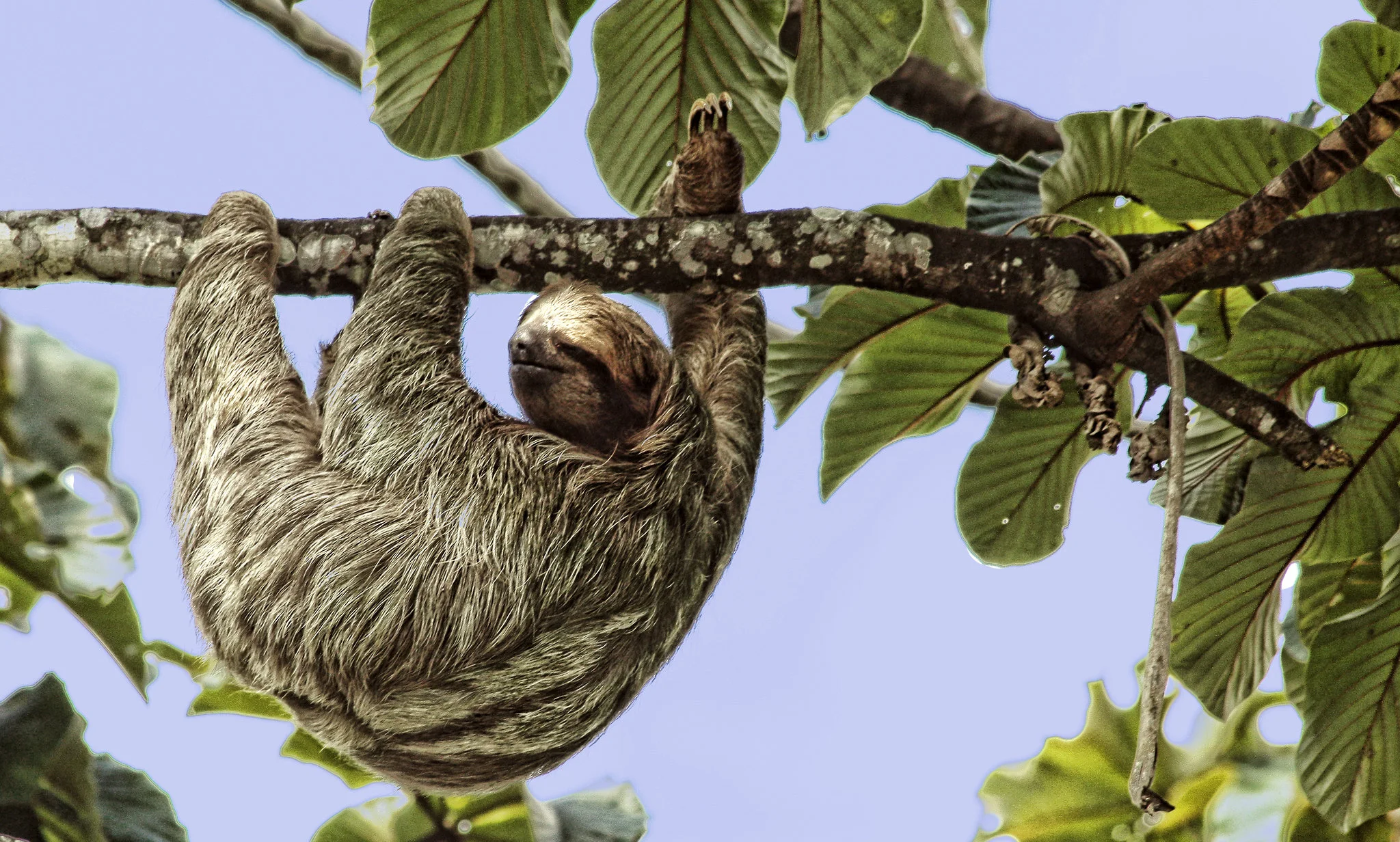
About once a week, a three-toed sloth risks its life to go to the toilet. It could simply go from the branch. Instead it climbs all the way down and digs a hollow with its stubby tail. It leaves its dung there, covers it and climbs back up.
On the ground a sloth is easy prey. In one study, more than half the dead sloths found had been killed by predators on or near the ground. A sloth is not a monkey. Its nearest relatives are anteaters.
In 2014 scientists in Costa Rica found a possible reason in its fur. Small moths live there. When the sloth climbs down, the female moths slip out and lay their eggs in its dung. The young grow up in the dung, then fly up into the trees to find a sloth of their own.
When the moths die, they rot in the fur and feed it. Green algae grows there, which is why sloths often look green. The scientists found this algae in sloths' stomachs, and it is rich in fat.
A sloth lives on the leaves of one or two trees, which is barely enough food. So the weekly climb down may be keeping a small garden going on its own back.