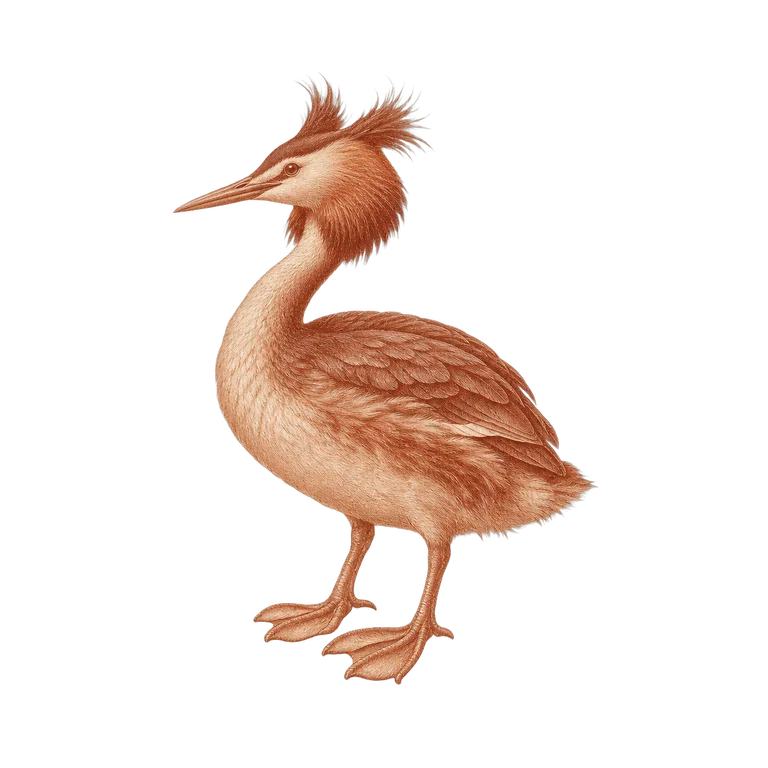
In the 1800s Britain nearly lost the great crested grebe to a fashion in hats.
The bird wears fine plumes on its head. Hunters killed it for them, to trim ladies' hats and clothes. A grebe is not a duck. Its feet have lobed toes, not webs, and its nearest relatives are flamingos.
Then people fought back. The Royal Society for the Protection of Birds was set up to help save it.
It worked. The grebe is a common sight again.
What was so nearly lost?
A bird famous for its courtship, for one thing. A paper about it by Julian Huxley, in 1914, became a landmark in the study of how birds behave.
It is the largest grebe in Europe, Asia and Africa, about half a metre long. It swims and dives superbly, and chases fish under water.
Its chicks can swim and dive almost as soon as they hatch. Their heads are striped black and white. People call them humbugs, after the striped sweet.
The parents carry them on their backs. That is how the lessons start. A parent dives, the chicks are left floating, and they have to swim back.
In 2023 the grebe even won an election. It was voted Bird of the Year in New Zealand, after a television host took up its cause.
From a trimming on a hat to Bird of the Year. The grebe has come a long way.